
We’ve developed a learning workshop for Erasmus+ grant applications, focusing on youth participation projects. It consists of eight 60-minute sessions. The idea is that you first read the indicated pages in the linked Erasmus+ program guide and then answer the questions. Ideally, you should complete the workshop together with the other members of your project group who want to submit the application. Over the eight sessions, you can work together to understand the Erasmus+ funding program and develop proposal concepts. You’ll probably need another one or two weekends to actually write your application.
If you have any questions, notice any errors, or have a project idea you’d like to pursue with us:
vernetzungpartizipation@riseup.net
Training at SALTO
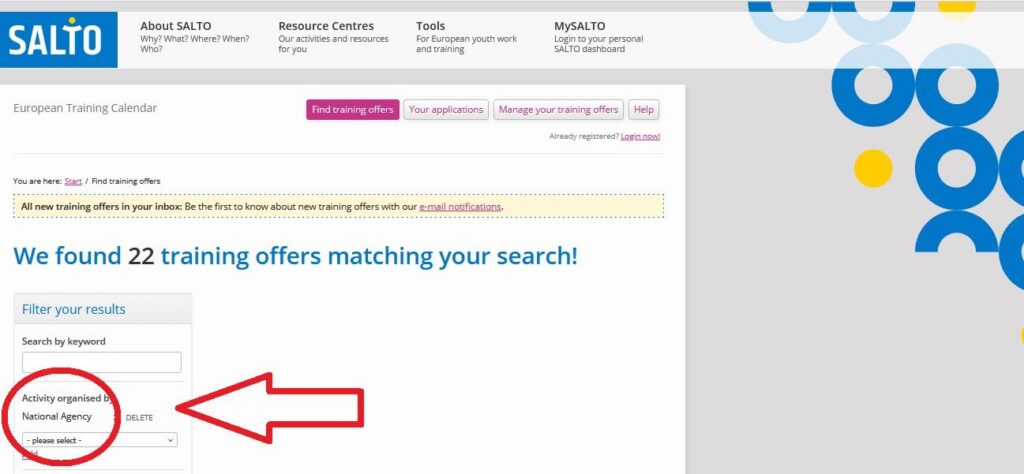
We also highly recommend the training offered by the National Agencies. The EU has at least one National Agency for Erasmus+ in every country. They are responsible for implementing the Erasmus+ program. That’s why the National Agencies regularly offer training courses where you can learn how to develop projects and applications for Erasmus+. You can find the training courses here:
https://www.salto-youth.net/tools/european-training-calendar/browse/
Use the search function
On the SALTO website, you’ll find a search function. Here you can filter your results to show only the training courses offered by the National Agencies. This will give you a quick overview!
Learning platform
Here is our list of course content and links to the learning materials:
1. EU Task: What is a youth participation project?
1.1. Create an account here:
https://webgate.ec.europa.eu/app-forms/af-ui-opportunities/#/erasmus-plus
a) Please click around on the site to familiarize yourself with the portal.
b) What kind of platform is it?
c) Who runs it?
d) What can it do?
1.2.
Please ask your favorite search engine for the National Agency for Erasmus+ youth in your country. Look at the website:
a) What is an National Agency? What are they doing? Why is it important?
b) What kind of information do you look for on websites like this?
c) Come up with two questions about the website yourself.
1.3. Somewhere on the page of national agency must be more information about Youth participation projects. Go find it.
1.4 Read it. 😉
a) What is important about Youth participation projects?
1.5 Critical reflection:
a) Why do they want to give us money?
b) Why do we want money from them in particular?
2. EU task: What is a measure to promote youth participation?
Read the big, fat book (Erasmus+ Programme Guidelines). You can find it in your language here:
https://erasmus-plus.ec.europa.eu/de/document/erasmus-programme-guide-2025-version-2?pk_content=pg-landing-download
And memorize it.
Just kidding. Please read the chapter „ACTIVITIES TO PROMOTE YOUTH PARTICIPATION“.
Questions:
2.1) How much is the travel allowance for a trip from Berlin to Helsinki?
a) How much for Leipzig-Berlin?
b) How much for Stuttgart-Berlin?
c) Where is this information located?
2.2. Partners and Activities
a) From which countries can the partner organizations come?
b) Do we need partner organizations?
c) Are we allowed to carry out activities in other countries?
d) Are we allowed to carry out activities on fancy places?
e) In which cities can we carry out mobility activities without having a partner organization in that country? (Since 2026, only three cities).
Why these specific cities?
2.3. How is the funding structured? Can someone present this as a formula?
a) What is the maximum amount of money our project can cost?
b) Trick question: Would we be allowed to buy alcohol with EU funding? If so, how much? And are we allowed to buy cocaine? Why not?
2.4. Who is eligible to submit applications?
a) Do we have to be a non-profit organization?
b) What is an informal group? Is this relevant to our project ideas?
2.5. Do you have any questions of your own?
3. EU Task: „What is the purpose of Erasmus+?“
3.1. Finding things
a) Please find the login for the Erasmus+ application platform again. Log in? Do you still remember your password?
b) How do I find the thick book with the rules on my favorite search engine if I’ve misplaced the link?
After finding the Erasmus+ guide, please read pages PART A – GENERAL INFORMATION ABOUT THE PROGRAM ERASMUS+.
3.2. What are priorities?
a) What are they?
b) How do they help us write our application?
3.3. Please come up with two questions of your own.
4. EU Task: Youth Goals
The European Union’s Youth Strategy is available at:
https://youth.europa.eu/strategy_en
Strategy for Youth Participation:
https://participationpool.eu/resource-category/youth-participation/youth-participation-strategy/
https://participationpool.eu/toolkit/
4.1. Come up with two questions yourself.
a) How will this help us when writing our application?
4.2. Develop a concept
a) What is our project title?
– Target group:
– Target group needs:
– Which priorities are we addressing?
– Project results:
– Project duration:
– Project components:
5. EU Task: The Alternative? Solidarity Projects in the Solidarity Corps
Please ask your favorite search engine for informations from your national agency about Solidarity projects in Europeen Solidarity corps (ESC).
5.1. What is the national agency in your country?
a) What is important here for our project?
Please read the chapter on solidarity projects in the handbook of ESC:
https://youth.europa.eu/solidarity/organisations/reference-documents-resources_en
5.2. What are the similarities between the youth participation project and the solidarity project?
– What are the differences?
– Which is better for our ideas?
6. EU Task: Timetable
6.1. Please create timelines for the project duration that align with the concepts developed in Lesson 4.
7. EU Task: The Fine Print
Please read the implementing regulations in the Erasmus+ Guide (last chapter).
7.1. Think of a question yourself.
7.2. Talking about money:
a) What happens to leftover money?
b) Where is this written down?
7.3. How do we do this?
a) Who is involved? Who decides when and how?
b) How do we spend the money?
7.4. Think of two questions for the EU.
More information:
Erasmus+ Guidelines:
https://erasmus-plus.ec.europa.eu/de/document/erasmus-programme-guide-2025-version-2?pk_content=pg-landing-download
European Solidarity Corps Guidelines:
https://youth.europa.eu/solidarity/organisations/reference-documents-resources_en
The application platform:
https://webgate.ec.europa.eu/app-forms/af-ui-opportunities/#/erasmus-plus