

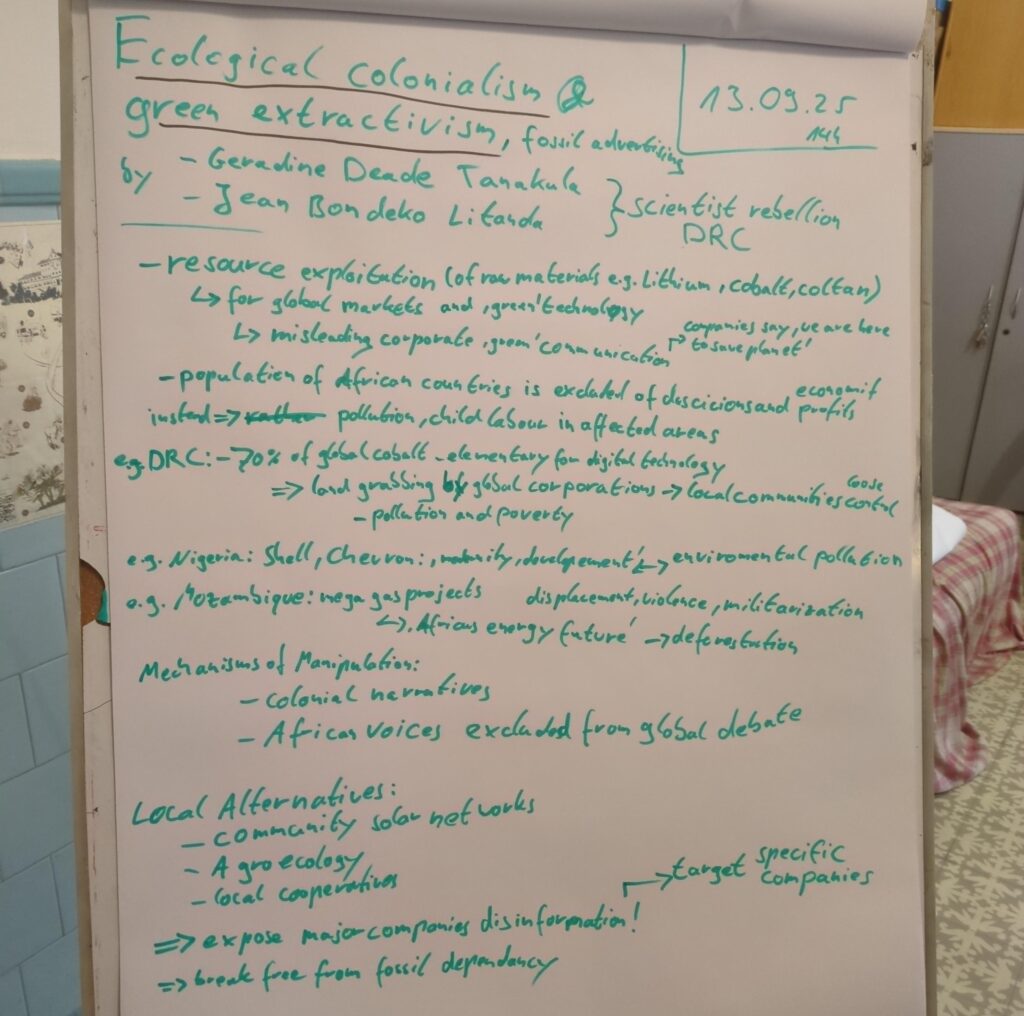
At the „ban fossil ads“ conference in Barcelona on Saturday, Geraldine Deade Tanakula from Scientist Rebellion DRC spoke about greenwashing in the Democratic Republic of Congo. She made it clear: There is no such thing as green capitalism for the energy transition. The exploitation of raw materials is destroying Congo, while the profits go to the global north. And the people of Congo are also being ripped off with greenwashing. And our author had an insight into his own racist thought patterns.
No visa
Unfortunately, we were only able to meet Geraldine Deade online because, unfortunately, she didn’t get a visa. This is all the more tragic because she and her NGO, the DGI Foundation are raising awareness of the concrete local impacts of fossil fuel advertising in the Global South. In her online lecture, Deade Tanakula explained how the idea of “green capitalism“ in the Global North is increasing the demand for raw materials for so-called „sustainable“ technologies like electric cars. Yet it is companies in the Global North that are mining, exporting, and profiting from rare earths like lithium and cobalt, using child labor.
Greenwashing
Through advertising, companies like TotalEnergies and Shell are constructing an image of „sustainable“ and „green“ economic growth in the Congo, which, however, is accompanied by the exploitation of people and nature. In doing so, these large corporations are committing land theft and displacing local communities who have to deal with environmental pollution caused by mining operations.
Sustainable Local Management
Instead of the exploitation of resources, Deade called for truly sustainable management of mines by local populations. She also called for more attention to the problematic impacts in the DRC and Africa caused by the energy and resource demands of countries like Germany. We must listen to the affected communities and use our scope for action to end this kind of „ecological colonialism.“
Neocolonial Racist Structures
Here, I wondered to what extent the neocolonial-racist structures of our exploitative economic system described by Deade also affect the FossilFreeAds movement. How can we ensure that future conferences around the world provide access to this space of power, especially in crucial face-to-face meetings, and ensure that our voices are heard? The expectations of almost exclusively Western European participants addressing a global problem should be higher here.
Plans
Geraldine Daede definitely has plans for this. She wrote to us after the conference: „As COP30 approaches, I think it’s a unique opportunity with thousands of people gathered, to amplify our voices and actions for real impact. Do we want to coordinate something visible together? Even a small but symbolic action could inspire and draw attention. I would also be happy to join from Africa and contribute to this collective effort. What ideas do you have that we could shape into a common initiative?“
What is COP30?
COP30 is the 30th World Climate Conference. Officially, it is a conference of the states that have signed the so-called „UN Protocol on Climate Change.“ COP30 will take place in the city of Belem, Brazil, from Monday, November 10, 2025, to Friday, November 21, 2025.
Self-awareness about racism
Something I take away from the conference has less to do with the conference than with; the way I see the world. Let me briefly describe the process of realizing this: I was sitting in the audience, and the lecture on greenwashing in the Congo was about to take place. I knew what greenwashing was. Until then, I also imagined myself to know an above-average amount about the Congo. There are two of them in Africa, and then the river of the same name, the Belgian colony, the rubber crimes, Mobutu, Bemba, the two Kabilas, the death sentence against Joseph, the embarrassing Bundeswehr mission in 2006, the resource wars with Rwanda, M23, war crimes against women, and the fact that more people have been murdered there than in the First World War.
Empty white space
Still, I have no idea what to expect from the lecture. I have a large, white, empty space in my head. A terra incocnita. Or a tabula rasa. All that’s missing is for me to start drawing arbitrary borders with a ruler… That’s a classic colonial, Eurocentric image of Africa.
The Exotic Other
Although I have no idea and a blank space in my mind, I imagine it as somehow „different,“ „exciting,“ and „exotic.“ The next exoticizing Africa stereotype. Moreover, the „different“ contains a process of othering. The fact that I have an „other“ in my mind that is far away „there“ means that I also have a „here“ that is „just like here.“ I now expect terrible stories from the Congo, while I imagine a relatively perfect world „here“ in comparison. This isn’t far from the classic colonial idea that divides the world into „civilization“ and „barbarism“ and places them in a hierarchy.
Just like here
What comes next sounds quite familiar: Just like „here,“ corporations „there“ are digging up raw materials for the energy transition to maximize profits. In doing so, they are causing massive damage to people and the environment. And they’re telling people the same greenwashing nonsense as here. And luckily, Deede’s Foundation is taking care of that. How could it be otherwise? Capitalism exists all over the planet?
Realization
The realization and the memory of what I was thinking before the talk irritates me massively and leads me to reflect and hopefully to a realization: I’ve now learned how racist „othering“ also works in my head. What will happen next? I don’t know yet. I’ll keep you updated.
And a fountain with palm trees and lights in Canyelles, which I really liked.
More info:
The Fossil Free Ads Gathering:
https://vernetzungpartizipation.noblogs.org/post/2025/10/09/our-trip-to-barcelona-for-the-ban-fossil-ads-gathering/
Ban fossil Ads – my personal conclusion:
The german version:
https://vernetzungpartizipation.noblogs.org/post/2025/10/09/bericht-vom-fossil-ad-ban-gathering-in-barcelona/